
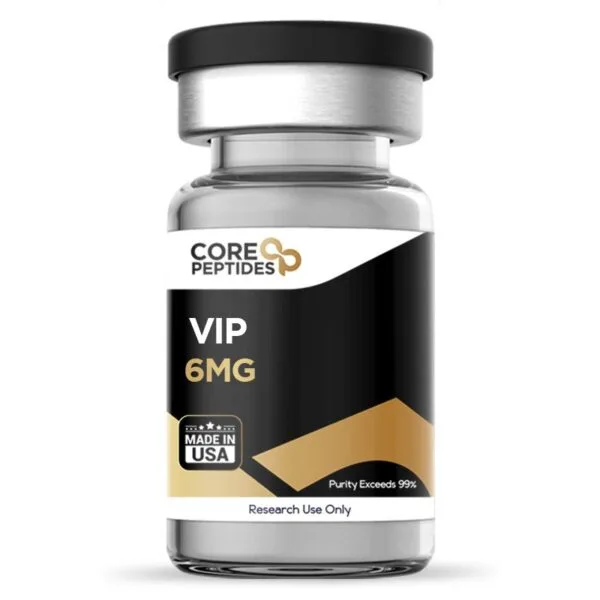


VIP Peptide
VIP Peptide (Vasoactive Intestinal Peptide) is a highly regarded synthetic peptide widely utilized in scientific and laboratory research. Known for its complex biological significance, VIP has become an important subject of investigation in studies involving cellular communication, peptide signaling pathways, and physiological regulatory mechanisms. As a naturally occurring neuropeptide found throughout various biological systems, VIP continues to attract interest from researchers seeking to better understand peptide-mediated functions and molecular interactions.
VIP Peptide consists of a sequence of amino acids that play a role in numerous biological signaling processes. Because peptides are essential components of many cellular functions, researchers frequently use VIP in controlled laboratory environments to examine receptor activity, biochemical pathways, and peptide-receptor interactions. Its unique molecular structure makes it a valuable research compound for investigations focused on understanding how signaling molecules influence cellular responses and communication networks.
Manufactured under strict quality control standards, VIP Peptide is supplied in a highly purified lyophilized powder form to help ensure product stability and consistency. The freeze-dried presentation allows researchers to conveniently store, handle, and reconstitute the peptide according to specific laboratory protocols. Maintaining peptide integrity is essential for achieving reliable and reproducible research outcomes, making quality and purity key considerations for any scientific study.
Researchers often select Vasoactive Intestinal Peptidebecause of its established role in scientific literature and its relevance to a variety of experimental models. The peptide continues to be explored in studies involving molecular biology, biochemistry, pharmacology, and peptide science. Ongoing research efforts seek to expand scientific understanding of VIP’s interactions with specialized receptors and its involvement in cellular signaling processes.
Key Features of Vasoactive Intestinal Peptide
* High-quality synthetic peptide for research applications
* Manufactured with strict quality assurance standards
* Supplied as lyophilized powder for enhanced stability
* Suitable for peptide-focused scientific investigations
* High purity and batch-to-batch consistency
* Convenient storage and handling for laboratory use
* Ideal for biochemical and molecular research studies
The growing interest in peptide-based research has highlighted the importance of compounds such as VIP Peptide. Scientists continue to investigate peptide signaling systems because of their fundamental role in biological communication. VIP serves as a valuable research tool for exploring these complex interactions and advancing scientific knowledge within the field of peptide science.
Proper storage conditions are recommended to preserve peptide quality. Lyophilized Vasoactive Intestinal Peptide is typically stored in a cool, dry environment, while long-term storage may require refrigeration or freezing according to laboratory guidelines. Once reconstituted, researchers should follow established handling procedures to maintain stability and minimize degradation.
Whether used in academic institutions, biotechnology laboratories, or advanced scientific research facilities, VIP Peptide remains a trusted option for investigators seeking a reliable peptide for experimental studies. Its recognized significance in peptide research, combined with rigorous manufacturing standards and high purity levels, makes VIP Peptide an excellent addition to research programs focused on molecular signaling and cellular biology.
Disclaimer: Vasoactive Intestinal Peptide is intended solely for laboratory research, analytical testing, and scientific investigation. It is not intended for human consumption, veterinary use, diagnosis, treatment, cure, or prevention of any disease. All handling and experimentation should be conducted by qualified professionals in accordance with applicable regulations and laboratory safety requirements.
References:
- National Center for Biotechnology Information (2022). PubChem Compound Summary for CID 7010502, Lysylglutamic acid. Retrieved November 21, 2022 from https://pubchem.ncbi.nlm.nih.gov/compound/Lysylglutamic-acid
- Lezhava T, Khavison V, Monaselidze J, Jokhadze T, Dvalishvili N, Bablishvili N, Barbakadze S. Bioregulator Vilon-induced reactivation of chromatin in cultured lymphocytes from old people. Biogerontology. 2004;5(2):73-9. https://pubmed.ncbi.nlm.nih.gov/15105581/
- Kazakova TB, Barabanova SV, Khavinson VKh, Glushikhina MS, Parkhomenko EP, Malinin VV, Korneva EA. In vitro effect of short peptides on expression of interleukin-2 gene in splenocytes. Bull Exp Biol Med. 2002 Jun;133(6):614-6. https://pubmed.ncbi.nlm.nih.gov/12447482/
- Sevostianova NN, Linkova NS, Polyakova VO, Chervyakova NA, Kostylev AV, Durnova AO, Kvetnoy IM, Abdulragimov RI, Khavinson VH. Immunomodulating effects of Vilon and its analogue in the culture of human and animal thymus cells. Bull Exp Biol Med. 2013 Feb;154(4):562-5. English, Russian. https://pubmed.ncbi.nlm.nih.gov/23486604/
- Khavinson VK, Anisimov VN, Zavarzina NY, Zabezhinskii MA, Zimina OA, Popovich IG, Shtylik AV, Malinin VV, Morozov VG. Effect of vilon on biological age and lifespan in mice. Bull Exp Biol Med. 2000 Jul;130(7):687-90. DOI: 10.1007/BF02682106. PMID: 11140587. https://pubmed.ncbi.nlm.nih.gov/11140587/
- Bykov NM, Chalisova NI. Osobennosti deĭstviia ul’tramalykh doz vilona v organotipicheskoĭ kul’ture selezenki krys raznogo vozrasta [Characteristics of effect of ultralow doses of vilon in organotypic culture of spleens from rats of various ages]. Adv Gerontol. 2002;10:85-7. Russian. PMID: 12577696.
- Kniaz’kin IV, Iuzhakov VV, Chalisova NI, Grigor’ev EI. Funktsional’naia morfologiia organotipicheskoĭ kul’tury selezenkoi krys razlichnogo vozrasta pri deĭstvii vilona [Functional morphology of organotypic culture of spleens from rats of various ages exposed to vilon]. Adv Gerontol. 2002;9:110-5. Russian. PMID: 12096432.
- Kniaz’kin IV, Poliakova VO. Deĭstvie vilona na timus i selezenku v radiatsionnoĭ modeli prezhdevremennogo stareniia [The effect of vilon on the thymus and spleen in a radiation model of premature aging]. Adv Gerontol. 2002;9:105-9. Russian. PMID: 12096431.
- Khavinson VKh, Anisimov VN. A synthetic dipeptide vilon (L-Lys-L-Glu) inhibits the growth of spontaneous tumors and increases the life span of mice. Dokl Biol Sci. 2000 May-Jun;372:261-3. PMID: 10944717. https://pubmed.ncbi.nlm.nih.gov/10944717/
- Pliss GB, Mel’nikov AS, Malinin VV, Khavinson VK. Inhibitory effect of peptide vilon on the development of induced rat urinary bladder tumors in rats. Bull Exp Biol Med. 2001 Jun;131(6):558-60. doi: 10.1023/a:1012354603132. PMID: 11586406.
- Barykina OP, Iuzhakov VV, Chalisova NI, Kvetnoĭ IM, Konovalov SS. Sochetannoe vliianie vilona i tsiklofosfana na transplanty opukholeĭ i éksplantaty limfoidnoĭ tkani mysheĭ i krys raznogo vozrasta [Combined effect of vilon and cyclophosphane on tumor transplants and lymphoid tissue explants in mice and rats of various age]. Adv Gerontol. 2003;12:128-31. Russian. PMID: 14743610. https://pubmed.ncbi.nlm.nih.gov/14743610/
- Khavinson VKh, Timofeeva NM, Malinin VV, Cordova LA, Nikitina AA. Effect of vilon and epithalon on activity of enzymes in epithelial and subepithelial layers in small intestine of old rats. Bull Exp Biol Med. 2002 Dec;134(6):562-4. https://pubmed.ncbi.nlm.nih.gov/12660839/
- Khavinson VKh, Egorova VV, Timofeeva NM, Malinin VV, Cordova LA, Gromova LV. Effect of Vilon and Epithalon on glucose and glycine absorption in various regions of small intestine in aged rats. Bull Exp Biol Med. 2002 May;133(5):494-6. https://pubmed.ncbi.nlm.nih.gov/12420071/
- Anisimov SV, Bokheler KR, Khavinson VKh, Anisimov VN. Studies of the effects of Vilon and Epithalon on gene expression in mouse heart using DNA-microarray technology. Bull Exp Biol Med. 2002 Mar;133(3):293-9. https://pubmed.ncbi.nlm.nih.gov/12360356/
- Kuznik BI, Isakova NV, Kliuchereva NN, Maleeva NV, Pinelis IS. [Effect of vilon on the immunity status and coagulation hemostasis in patients of different age with diabetes mellitus]. Adv Gerontol. 2007;20(2):106-15. Russian. PMID: 18306698. https://pubmed.ncbi.nlm.nih.gov/18306698/
- Gavrisheva NA, Malinin VV, Ses TP, Kozlov KL, Panchenko AV, Titkov AY. Effect of peptide Vilon on the content of transforming growth factor-beta and permeability of microvessels during experimental chronic renal failure. Bull Exp Biol Med. 2005 Jan;139(1):24-6. DOI: 10.1007/s10517-005-0202-9. PMID: 16142267. https://pubmed.ncbi.nlm.nih.gov/16142267/
3 reviews for Vasoactive Intestinal Peptide (VIP) (6mg)
Add a review
Related products


James Wilson (verified owner) –
Great product consistency and professional packaging. Will order again.
Customer 1356 (verified owner) –
Outstanding customer service and top-quality products.
Customer 4170 (verified owner) –
The products arrived fresh and well-packaged.